"My ID, My Right / Aqoonsigayga Waa Xuquuqdayda" by Ann Macleod

Kenya's digital identity system, Maisha Namba, aims to digitalise civil and personal registration, utilising a Unique Personal Identification (UPI) and Digital ID, among other features.
However, the system fails to address issues previously identified by PI and its partners. Haki na Sheria Initiative (HSI) has flagged potential constitutional violations, including of the right to privacy and discrimination against marginalised communities.
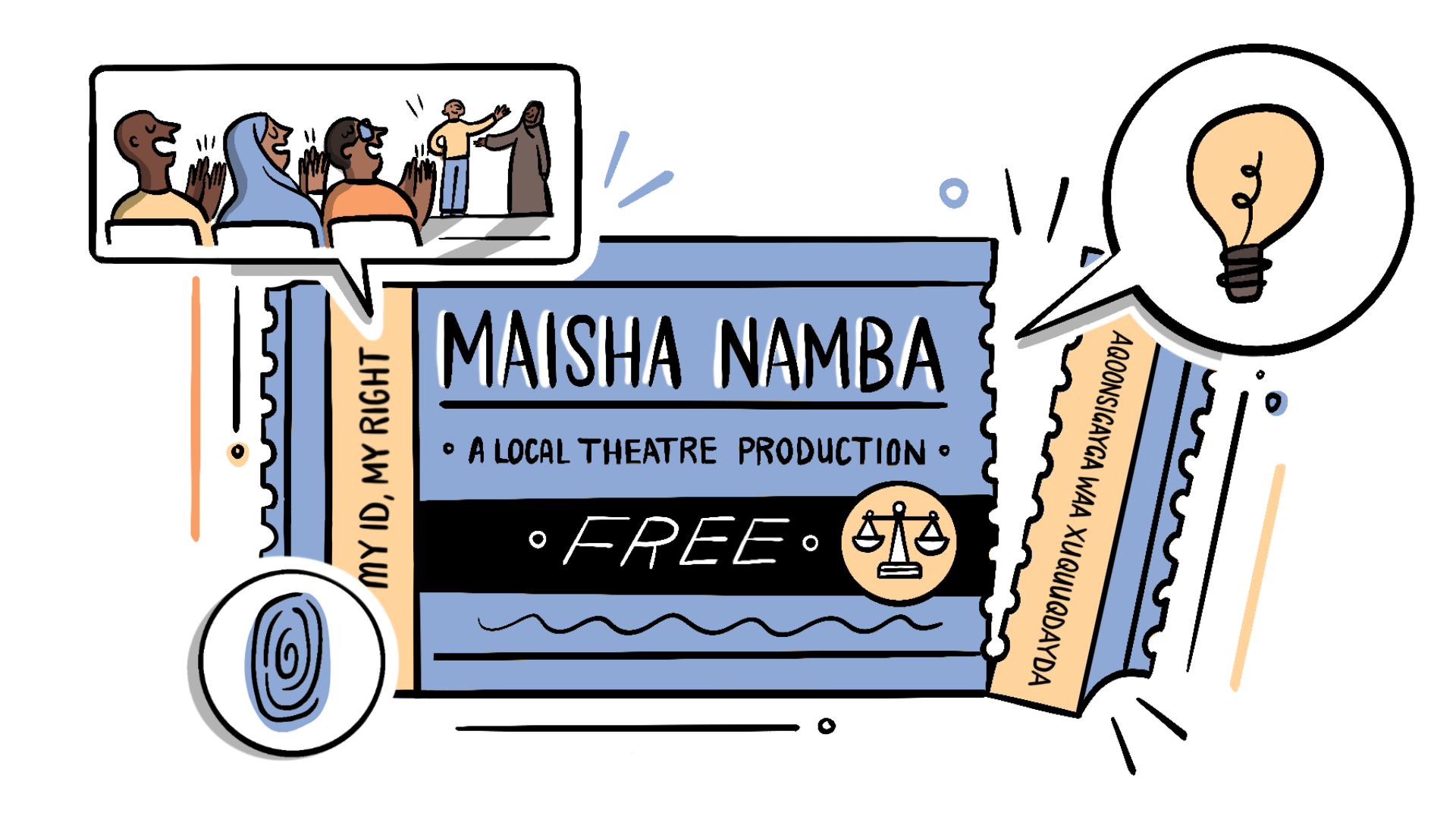
In response, HSI organised the community-led play: "My ID, My Right / Aqoonsigayga Waa Xuquuqdayda".
"My ID, My Right / Aqoonsigayga Waa Xuquuqdayda" by Ann Macleod
In Garissa Town, Kenya, on a warm evening in late October, a crowd gathered not for a rally or a court hearing, but for a play. Paralegals took the stage alongside community members, performing in Somali, Swahili and English. The story they told was about an identity document, a number: Maisha Namba. Now woven into Kenya's new digital identity system, this ID determines who gets left behind when a government decides that a number should represent a person.
Nobody in that crowd had come to learn about biometric registries or civil registration law. They had come because a friend, a paralegal, a chief, or a neighbour told them there would be drama, laughter, and recognition. But by the time the lights came up, something had shifted. People who had walked in unsure of what Maisha Namba was, walked out able to name the risks it carried, and the rights it was supposed to protect.
The performance, staged by Haki na Sheria Initiative (HSI) under the title "My ID, My Right / Aqoonsigayga Waa Xuquuqdayda" was the first of three. It would be repeated in Kamuthe three weeks later, then again in Wabiri Ward the following February, each time drawing in more people, more questions, and more of the community to have the conversation that Kenya's government had, until then, largely kept behind closed doors.
Walk into HSI's offices and a creative, community-rooted way of addressing rights is visible everywhere you look. The walls carry art that is shaped around the organisation's areas of work – citizenship, land, and justice – turning the building itself into something closer to an art gallery than a legal office. The atmosphere is lively and unguarded, the kind of place where the gate is never really a barrier: staff greet visitors warmly, ready to welcome whoever walks through, whether they've come with a legal problem or simply a question. It is easy to see, standing in that space, why paralegals could walk into Garissa Town and stage a play about digital identity and have a community actually show up, listen, and stay.
This is not the first time North-Eastern Kenya has lived through the consequences of a flawed registration system.
Back in 2016, a population verification exercise across the Dadaab camps re-counted everyone registered there for the first time in three years. Of roughly 341,500 people on record, only around 283,500 could actually be accounted for on the ground. Buried in that gap was something more troubling than absence: 24,655 people who turned out to be registered as refugees despite being Kenyan citizens, alongside another 3,355 households (nearly 15,800 people) of which at least one member had applied for or already held a Kenyan national ID. All told, 40,454 people were caught in this overlap between two identity systems, unable to say with certainty which one recognised them, or what that meant for their access to services, movement, or protection (UNHCR Dadaab update, 15 September 2016).
When identity systems expand – whether it's a camp registry like that of 2016 or the digital rollout that took place a decade later, the people most likely to fall through the cracks are the ones who were never informed what data was being collected about them, for what reason, and for what purpose. Double registration in Dadaab was not really a story about dishonesty; it was a story about a system that moved faster than the information and consent people needed to navigate it safely. A similar risk exists with Maisha Namba. Digitisation can widen, not narrow, exclusion, if communities are not equipped to understand how their data is used and what rights they retain over it.
Garissa County sits in North-Eastern Kenya, home to pastoralist communities and a refugee population who have long faced documentation barriers that urban, connected Kenyans rarely need to think about. When the Kenyan government began rolling out Maisha Namba, tied ever more tightly to essential services and, increasingly, to political participation ahead of the 2027 elections, the risks of exclusion were not hypothetical. They were the latest chapter in a familiar story for communities who already carry the heaviest burden of proving their identities.
A policy brief alone could never capture the issue at the heart of Maisa Namba. In a region where formal literacy in government processes is low and trust in state institutions is fragile, the most powerful form of civic education is not a workshop with a whiteboard. It is a story of struggle that people recognise as their own. That is precisely the gap that the plays in Garissa Town, Kamuthe and Wabiri Ward were created to fill.
The change in Garissa was not subtle. Before the plays, most people in the audience may not have been able to tell you what Maisha Namba was, let alone what rights or risks came with it. But by the end of the evening, people were asking more difficult questions than the ones the play had answered, and many were eager to carry what they'd learned home, explaining it to family, friends, and neighbours who hadn't seen the performance.
So who showed up? Two-thirds of the audience were women. At the final event in Waberi Ward, women made up three-quarters of the room, a striking result in a context where formal civic spaces so often exclude women by default. Nearly half of the audience was under the age of 35. These were not the people typically found at the centre of a policy conversation about digital identity; they were the people with the most at stake in it. For one evening, the room was built around these people, rather than around government officials, lawyers and policy makers. The videos and infographics that followed, produced by HSI in English, Somali and Swahili, carried that same conversation online to thousands more.
Behind the plays sat something more consequential: a legal case challenging the Maisha Namba system itself, and a research report that lays bare gaps that the government has never publicly addressed, including exactly what data is collected and under what conditions different actors can access it.
The report has been written, but it cannot yet be published. The hearing meant to anchor its release has been postponed twice, most recently because the presiding judge was transferred to another court. HSI has adapted without giving up ground, holding its strongest material back for the moment it can land with real strategic force.
It is a reminder that human rights work in a place like Garissa is rarely possible to conduct in a straight line. It requires patience with institutions that do not always move at the speed of justice, and a willingness to keep community trust alive in the meantime.
HSI is building something more permanent: the BUNI Art Hub, a civic learning and creative space reimagined from the A'qal; the domed shelter traditionally built by Somali pastoralist communities. The hub will be co-designed and built, plank by plank, by pastoralist women in Garissa themselves.
The idea grew directly out of what happened in Garissa Town, Kamuthe and Wabiri Ward: people didn't just want to be told about their rights once and sent home. They wanted a space to keep asking questions about digital identity and other challenges shaping their daily lives: land, movement, and access to justice. They wanted somewhere to bring their ideas to the table, rather than simply ingesting information. BUNI is HSI's attempt to build that space: somewhere people can help build and return to frequently.
Turning a moment of awareness into lasting engagement takes more than a single performance. It takes a place to come back to, one that belongs to the community.
The story of Maisha Namba in Garissa is not just about one identity system in one region of Kenya. It is about what happens when the communities most exposed to the risks of digital identification are given the tools to understand them, and a platform to demand better. It is about a small paralegal-led organisation choosing not to wait for permission to make complex rights legible to the people they affect most.
HSI's work is a reminder of something easy to lose sight of in the world of legal briefs and policy submissions: that the fight for digital rights is ultimately a fight to make sure that people – and in particular affected communities – understand what is being asked of them; know when their data is being used without their consent; and are equipped to say no when the answer should be no.
The play in Garissa Town ended, as plays do, with the audience going home. But for many of them, it was the first time anyone explained the impact of Maisha Namba on their lives. That kind of change does not show up in a single evening's applause. It shows up months later, amongst a community that is aware of its rights and is no longer willing to be left out of the conversation about its own identity.
This article was written by Haki na Sheria Initiative (HSI), a human rights organisation based in Garissa Town, North-Eastern Kenya, working on citizenship rights, land governance, and access to justice with pastoralist communities and refugee-hosting populations across Garissa, Tana River, and Lamu counties.