
Search

Content type: Long Read
This week, Privacy International, together with nine other international human rights NGOs, filed submissions with the European Court of Human Rights. Our case challenges the UK government’s bulk interception of internet traffic transiting fiber optic cables landing in the UK and its access to information similarly intercepted in bulk by the US government, which were revealed by the Snowden disclosures. To accompany our filing, we have produced two infographics to illustrate the…
Content type: Press release
PI Research Officer Edin Omanovic said:
“The European Commission has proposed sweeping updates [PDF] to trade regulations in an effort to modernise the EU’s export control system and to ensure that the trade in surveillance technology does not facilitate human rights abuses or internal repression.
Privacy International welcomes the intentions of the proposed changes in terms of protecting human rights as it does all such moves. More than half of the world’s surveillance…
Content type: Press release
Key points
Privacy International, Liberty, Amnesty International, and seven other human rights organizations challenge UK mass surveillance and UK access to US mass surveillance at the European Court of Human Rights
This is the first case before the European Court of Human Rights to directly challenge UK and US mass surveillance revealed by the Snowden disclosures
National courts and oversight bodies have failed to rein in mass surveillance practices that impact hundreds of millions of…

Content type: Long Read
This report examines the emergence of social media based surveillance in Thailand, carried out potentially by people’s own networks of friends and family. It looks at the severe impact this has on personal privacy and points to potential solutions.
In May 2014, Thailand experienced a military coup – its second in eight years. A military government led by General Prayut Chan-o-cha seized power and overthrew the administration of Prime Minister Yingluck Shinawatra. The Army declared martial…
Content type: News & Analysis
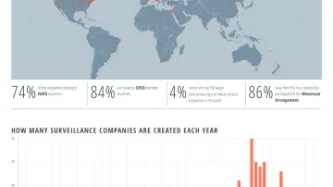
Privacy International is today proud to release the Surveillance Industry Index (SII), the world's largest publicly available educational resource of data and documents of its kind on the surveillance industry, and an accompanying report charting the growth of the industry and its current reach.
The SII, which is based on data collected by journalists, activists, and researchers across the world is the product of months of collaboration between Transparency Toolkit and Privacy…

Content type: News & Analysis
Another committee-led scrutiny. Another list of changes that need to be made to the Investigatory Powers Bill. This seems familiar.
The Joint Committee on Human Rights has weighed in with scrutiny of the Investigatory Powers Bill prior to the Bill’s debate and vote in the House of Commons on the 6 and 7 June. The recommendations the report contains once again raise questions about the fitness of the Bill to be passed in its current form.
The Committee identified thematic warrants - which…
Content type: News & Analysis
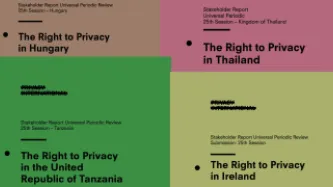
Over the next two weeks, the 25th session of the Universal Period Review Working Group will take place in Geneva. The Universal Period Review is a key mechanism of the UN Human Rights Council to remind UN Member States of their responsibility to respect and implement all human rights and fundamental freedoms.
Amongst others, Hungary, the United Republic of Tanzania, Thailand, and Ireland will be reviewed. Privacy International, in collaboration with national civil society…
Content type: Long Read
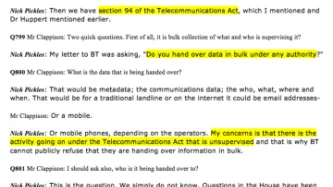
1984: A broad law, a broad power and a whole lot of secrecy
In the wake of litigation brought by Privacy International (‘PI’) and as the Government prepared to introduce the Draft Investigatory Powers Bill (‘IP Bill’) in November 2015, there was a cascade of ‘avowals’- admissions that the intelligence agencies carry out some highly intrusive surveillance operations under powers contained in outdated and confusing legislation.
It is disappointing that it has been almost six months since…

Content type: News & Analysis
PI's full analysis can be read here
On 29 February 2016, the European Commission and the US government released the details of the proposed EU-U.S. “Privacy Shield”. The “Privacy Shield” replaces the now defunct so-called “Safe Harbor”.
The Privacy Shield is in fact a significant number of documents from various parts of the U.S. administration, which merely outline the existing, weak U.S. safeguards applicable to personal data of EU citizens. These documents are…
Content type: Advocacy
This stakeholder report is a submission by Privacy International (PI) and Thai Netizen Network (TNN). PI is a human rights organisation that works to advance and promote the right to privacy and ght surveillance around the world. TNN is a Bangkok-based organisation that works to promote human rights in Internet policy and support the work of human rights defenders in digital environment. PI and TNN wish to to bring concerns about the protection and promotion of the right to privacy in…
Content type: Long Read
The Investigatory Powers Tribunal (“IPT”) today held that GCHQ hacking of computers, mobile devices and networks is lawful, wherever it occurs around the world. We are disappointed that the IPT has not upheld our complaint and we will be challenging its findings.
Our complaint is the first UK legal challenge to state-sponsored hacking, an exceptionally intrusive form of surveillance. We contended that GCHQ hacking operations were incompatible with democratic principles and human rights…