
Search

Content type: Advocacy
Thornsec is a piece of software developed by Privacy International’s Tech Team which is an automated way to deploy, test, and audit internal and external services for an organisation, saving a lot of time and creating a sustainable security model. We are using this software to run all of Privacy International’s services – website, calendar, project management tools, Tor hidden services, VPNs. The whole system runs on two servers and the whole cost is around US$1000 to set up.
Thornsec is…

Content type: Advocacy
Privacy International has responded to the European Commission’s consultation on the interoperability of EU information systems for borders and security.
The Commission is currently looking at ways in which various border control and policing EU databases and IT systems can be connected to share and exchange more data.
The plans raise a number of concerns as highlighted by Privacy International in our response. These relate to significant potential harms associated with…

Content type: News & Analysis
For further information on timeline and case history, read this briefing.
Arguments
The argument were based on the written submissions of the parties. The oral statements summarised key points in these submissions.
The submissions can be found on PI’s website under Legal Action. In terms of today’s proceedings (these are now available through webcast)
Counsel for the UK Government, James Eadie QC started off proceedings, his opening arguments were: 1) The issues are of…
Content type: Press release
The European Court of Human Rights will hear a landmark case on surveillance tomorrow (7 November) as part of a challenge to the lawfulness of the UK’s surveillance laws and its intelligence agencies’ mass surveillance practices.
See the attached briefing for case background and historical information.
The case, described by campaigners as a “watershed moment for people’s privacy and freedom of expression across the world”, is being brought by Amnesty International, Liberty, Privacy…
Content type: Advocacy
Our full briefing is here.
Content type: News & Analysis
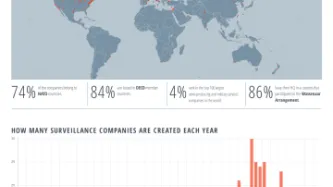
Privacy International launches the Surveillance Industry Index & New Accompanying Report
Privacy International is today proud to release the Surveillance Industry Index (SII), the world's largest publicly available educational resource of data and documents of its kind on the surveillance industry, and an accompanying report charting the growth of the industry and its current reach.
The SII, which is based on data collected by journalists, activists, and researchers across the world…
Content type: Report
This report sheds light on the current state of affairs in data retention regulation across the EU post the Tele-2/Watson judgment. Privacy International has consulted with digital rights NGOs and industry from across the European Union to survey 21 national jurisdictions (Austria, Belgium, Bulgaria, Croatia, Cyprus, Czech Republic, France, Germany, Hungary, Ireland, Italy, Luxembourg, the Netherlands, Poland, Portugal, Romania, Slovakia, Slovenia, Spain, Sweden, and the United Kingdom).…
Content type: Press release
Key points
Privacy International surveyed 21 EU member states' legislation on data retention and examined their compliance with fundamental human rights standards
0 out of the 21 States examined by PI are currently in compliance with these standards (as interpreted in two landmark judgements by the Court of Justice of the European Union: Tele-2/Watson and Digital Rights Ireland)
Privacy International is calling for:
EU member states to review their legislation on data retention…

Content type: Advocacy
Privacy International's response to the inquiry by the House of Lords Select Committee on Artificial Intelligence.
Content type: Press release
While welcoming the objective of the Bill, Privacy International has sent a briefing to the House of Lords and a letter to Minister of State for Digital, Matt Hancock MP, outlining key concerns and recommendations. The Bill's stated aim is “to create a clear and coherent data protection regime”, and to update the UK data protection law, including by bringing the EU General Data Protection Regulation (GDPR) and the Data Protection Law Enforcement Directive (DPLED) - into the UK domestic system.…
Content type: Advocacy
Privacy International welcomes the aim of this Bill (Data Protection Bill), “to create a clear and coherent data protection regime”, and to update the UK data protection law, including by bringing the EU General Data Protection Regulation (GDPR) and the Data Protection Law Enforcement Directive (DPLED) - into the UK domestic system. This is Privacy International’s briefing on the Data Protection Bill for second reading in the House of Lords
Content type: Long Read
European Court of Human Rights Intervention
On 15 September 2017, Privacy International filed an intervention to the European Court of Human Rights in Association Confraternelle de la Presse Judiciare and 11 Other Applications v. France. This case challenges various surveillance powers authorised under the French Intelligence Act of 24 July 2015 as incompatible with Articles 8 and 10 of the European Convention on Human Rights, which respectively protect the right to privacy…
Content type: Press release
Key points
Privacy International surveyed 21 EU member states' legislation on data retention and examined their compliance with fundamental human rights standards
0 out of the 21 States examined by PI are currently in compliance with these standards (as interpreted in two landmark judgements by the Court of Justice of the European Union: Tele-2/Watson and Digital Rights Ireland)
Privacy International is calling for:
EU member states to review their legislation on data retention…
Content type: Advocacy
This report sheds light on the current state of affairs in data retention regulation across the EU post the Tele-2/Watson judgment. Privacy International has consulted with digital rights NGOs and industry from across the European Union to survey 21 national jurisdictions (Austria, Belgium, Bulgaria, Croatia, Cyprus, Czech Republic, France, Germany, Hungary, Ireland, Italy, Luxembourg, the Netherlands, Poland, Portugal, Romania, Slovakia, Slovenia, Spain, Sweden, and the United…

Content type: News & Analysis
Privacy International (PI) has today written to the Danish Ministry of Foreign Affairs following further concerning reports about the export of internet surveillance equipment from the country.
We are calling for the government to carry out a full re-assessment of the human rights risks associated with the export of such internet surveillance equipment, and to revoke all licenses where there is a risk to human rights or if the law governing surveillance in the destination country is…
Content type: Press release
Please find attached a copy of the briefing along with promotional photographs with the briefing.
Privacy International has today sent top EU and UK Brexit negotiators* a briefing on their vulnerability to potential surveillance by each other, and others. Brexit negotiations are to begin today.
The global privacy rights NGO has highlighted to the negotiators the risk of sophisticated surveillance capabilities being deployed against each other and by others, and provided…
Content type: Advocacy
Privacy International generally opposes hacking as a tool for surveillance. While the DDL Orlando is an opportunity to fill the current legislative gap in the use of hacking for investigative purposes, PI believes that it falls short of the requirements of existing international human rights law.

Content type: Advocacy
Privacy International's submission on the right to privacy in Thailand, Human Rights Committee, 119th Session.
In our assessment to the Committee, national legislation governing surveillance is inadequate, unclear as to the powers, scope and capacity of state surveillance activities and thus it falls short of the required human rights standards to safeguard individuals from unlawful interference to the right to privacy.

Content type: State of Privacy
Introduction
Acknowledgment
The State of Surveillance in Thailand is the result of a collaboration by Privacy International and Thai Netizen Network.
Right to Privacy
The constitution
Thailand experienced a coup d'etat in May 2014. According to Mishari Muqbil and Arthit Suriyawongkul, “their [the junta's] modus operandi seems to be the direct command of ministries and semi-governmental organisations to carry out tasks irrespective of existing legislation.”
Following…

Content type: News & Analysis
In our latest report “Who’s that knocking at my door? Understanding surveillance in Thailand”, we highlighted various methods of surveillance that the Thai Government employs. Included in these methods was the finding that Microsoft was the only technology company which by default trusts the Thai Government’s root certificate. Root certificates ensure the validity of a website, and protect users from being tricked into visiting a fake, insecure website. Most technology companies including Apple…

Content type: News & Analysis
An investigation released by Privacy International this week reveals the Facebook shut-down Thailand experienced in May 2014, at the height of the military coup, may have had more to do with attempting to surveil online communications, rather than censoring Facebook users. This revelation indicates there could be more to other previous internet shutdowns that have happened during times of political unrest.
In May 2014, following months of protest, the Thai military overthrew the…

Content type: Report
This investigation looks at how surveillance is being conducted in Thailand. The first part of the investigation focuses on the ties between telecommunication companies and the state, and the second part of the investigation focuses on attacks conducted in order to attempt to circumvent encryption.

Content type: Long Read
This week, Privacy International, together with nine other international human rights NGOs, filed submissions with the European Court of Human Rights. Our case challenges the UK government’s bulk interception of internet traffic transiting fiber optic cables landing in the UK and its access to information similarly intercepted in bulk by the US government, which were revealed by the Snowden disclosures. To accompany our filing, we have produced two infographics to illustrate the…
Content type: Press release
PI Research Officer Edin Omanovic said:
“The European Commission has proposed sweeping updates [PDF] to trade regulations in an effort to modernise the EU’s export control system and to ensure that the trade in surveillance technology does not facilitate human rights abuses or internal repression.
Privacy International welcomes the intentions of the proposed changes in terms of protecting human rights as it does all such moves. More than half of the world’s surveillance…
Content type: Press release
Key points
Privacy International, Liberty, Amnesty International, and seven other human rights organizations challenge UK mass surveillance and UK access to US mass surveillance at the European Court of Human Rights
This is the first case before the European Court of Human Rights to directly challenge UK and US mass surveillance revealed by the Snowden disclosures
National courts and oversight bodies have failed to rein in mass surveillance practices that impact hundreds of millions of…

Content type: Long Read
This report examines the emergence of social media based surveillance in Thailand, carried out potentially by people’s own networks of friends and family. It looks at the severe impact this has on personal privacy and points to potential solutions.
In May 2014, Thailand experienced a military coup – its second in eight years. A military government led by General Prayut Chan-o-cha seized power and overthrew the administration of Prime Minister Yingluck Shinawatra. The Army declared martial…
Content type: News & Analysis
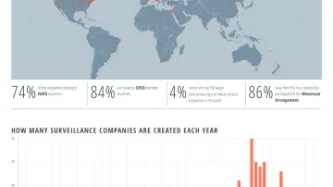
Privacy International is today proud to release the Surveillance Industry Index (SII), the world's largest publicly available educational resource of data and documents of its kind on the surveillance industry, and an accompanying report charting the growth of the industry and its current reach.
The SII, which is based on data collected by journalists, activists, and researchers across the world is the product of months of collaboration between Transparency Toolkit and Privacy…

Content type: News & Analysis
Another committee-led scrutiny. Another list of changes that need to be made to the Investigatory Powers Bill. This seems familiar.
The Joint Committee on Human Rights has weighed in with scrutiny of the Investigatory Powers Bill prior to the Bill’s debate and vote in the House of Commons on the 6 and 7 June. The recommendations the report contains once again raise questions about the fitness of the Bill to be passed in its current form.
The Committee identified thematic warrants - which…

Content type: News & Analysis
Over the next two weeks, the 25th session of the Universal Period Review Working Group will take place in Geneva. The Universal Period Review is a key mechanism of the UN Human Rights Council to remind UN Member States of their responsibility to respect and implement all human rights and fundamental freedoms.
Amongst others, Hungary, the United Republic of Tanzania, Thailand, and Ireland will be reviewed. Privacy International, in collaboration with national civil society…
Content type: Long Read
1984: A broad law, a broad power and a whole lot of secrecy
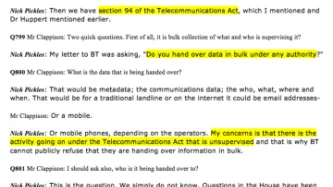
In the wake of litigation brought by Privacy International (‘PI’) and as the Government prepared to introduce the Draft Investigatory Powers Bill (‘IP Bill’) in November 2015, there was a cascade of ‘avowals’- admissions that the intelligence agencies carry out some highly intrusive surveillance operations under powers contained in outdated and confusing legislation.
It is disappointing that it has been almost six months since…