
Advanced Search

Content Type: Report
While identity systems pose grave dangers to the right to privacy, based on the particularities of the design and implementation of the ID system, they can also impact upon other fundamental rights and freedoms upheld by other international human rights instruments including the International Covenant on Civil and Political Right and the International Covenant on Economic, Social and Cultural Rights such as the right to be free from unlawful discrimination, the right to liberty, the right to…

Content Type: Report
Rather than providing a list of arguments, as is the case in the other sections of this guide, the fifth section provides a general overview describing the absence of consideration of these themes in existing jurisprudence and the reasons why these themes warrant future consideration including identity systems’ implications for the rule of law, the role of international human rights law, and considerations of gender identity.
Democracy, the Rule of Law and Access to Justice: This analysis of…

Content Type: Press release
Today, the European Court of Human Rights (ECtHR) has handed down a decision in a case brought by Privacy International and a coalition of internet and communications service providers and campaign groups including the Chaos Computer Club (Germany), GreenNet (UK), Jinbonet (Korea), May First/People Link (US), and Riseup (US) (the “coalition”).The case challenges the conduct of hacking operations abroad by one of the UK’s intelligence agencies, the Government Communications…

Content Type: News & Analysis
A new report by the UN Working Group on mercenaries analyses the impact of the use of private military and security services in immigration and border management on the rights of migrants, and highlights the responsibilities of private actors in human rights abuses as well as lack of oversight and, ultimately, of accountability of the system.
Governments worldwide have prioritised an approach to immigration that criminalises the act of migration and focuses on security.
Today, borders are not…

Content Type: Case Study
Numerous sexist, mysoginistic, homophobic and racist practices are flourishing online, in ways that are harder for national authorities to stop than when abuse takes place offline. One of these practices is ‘revenge pornography’, which involves online distribution of private sexual images without the consent of the person depicted.
One victim of image based sexual abuse (more commonly known as revenge porn): Chrissy Chambers. Chrissy was 18 years old when her boyfriend convinced her to spend…

Content Type: Press release
MI6 has been forced to apologise to the Investigatory Powers Tribunal after two of its officers asked court staff to return documents relating to MI6’s use of agents and not show them to judges. The Tribunal suggested MI6’s actions were “inappropriate interference”.
The revelation emerged in an ongoing legal case considering what crimes intelligence informants are allowed to commit, after it was revealed that MI5 maintains a secret policy under which agents can be “authorised” to…

Content Type: Explainer
Definition
An immunity passport (also known as a 'risk-free certificate' or 'immunity certificate') is a credential given to a person who is assumed to be immune from COVID-19 and so protected against re-infection. This 'passport' would give them rights and privileges that other members of the community do not have such as to work or travel.
For Covid-19 this requires a process through which people are reliably tested for immunity and there is a secure process of issuing a document or other…

Content Type: Long Read
Over the last two decades we have seen an array of digital technologies being deployed in the context of border controls and immigration enforcement, with surveillance practices and data-driven immigration policies routinely leading to discriminatory treatment of people and undermining peoples’ dignity.And yet this is happening with little public scrutiny, often in a regulatory or legal void and without understanding and consideration to the impact on migrant communities at the border and…

Content Type: Advocacy
Privacy International and Hiperderecho made a joint submission to the UN Committee on the Elimination of all Forms of Discrimination Against Women (CEDAW) ahead of the Committee finalising the list of issues for the examination of Peru.
The submission builds on research commissioned by Privacy International and carried out by Hiperderecho on the state of reproductive rights in Peru, and how their exercise intersects with privacy and tech.
The submission is available in…

Content Type: News & Analysis
In September 2019, PI published the report Your Mental Health for Sale. Our investigation looked into popular mental health websites and their data sharing practices.
Our findings suggest that, at the time of the research, most websites we looked at were using third party tracking for advertising purposes, sometimes relying on programmatic advertising technologies such as Real Time Bidding (RTB), sharing personal data with potentially thousands of actors. Some websites were also found sharing…

Content Type: Case Study
The EU have been using foreign aid budgets, not to lift people out of poverty, but to export surveillance technologies used to repress people’s human rights all over the world.
A wave of anti-immigration fervour has swept across Europe in recent years. As leaders have come to power across Europe either on anti-immigration platforms or having to respond to an anti-immigration sentiment, the EU’s recent policies have been shaped by the drive to stop migration to Europe.
Surveillance…

Content Type: Report
The majority of people today carry a mobile phone with them wherever they go, which they use to stay connected to the world. Yet an intrusive tool, known as an International Mobile Subscriber Identity catcher, or “IMSI catcher” is a form of surveillance equipment that enables governments and state authorities to conduct indiscriminate surveillance of mobile devices, and by extension, on users.
IMSI catchers can do much more than monitor and intercept mobile communications. Designed to imitate…

Content Type: News & Analysis
Name: Google/Fitbit mergerAge: GestatingAppearance: A bit dodgy. One of the world’s biggest tech giants, trying to purchase a company that makes fitness tracking devices, and therefore has huge amounts of our health data.I don’t get it. Basically Google is trying to buy Fitbit. As if Google doesn’t already have enough data about us, it now wants huge amounts of health data too.Oh, Fitbit, that’s that weird little watch-type-thing that people get for Christmas, wear for about a month while they…

Content Type: Video
Immediately following the UK general election in December 2019, we worked with Open Rights Group to commission a YouGov poll about public understanding and public opinion about the use of data-driven campaigning in elections.
The poll used a representative sample of 1,664 adults across the UK population.
'Data-driven political campaigning' is about using specific data about you to target specific messages at you. So, for this might involve knowing that you are, for example, likely to…

Content Type: News & Analysis
IMSI catchers (or stingrays as they are known in the US) are one of the surveillance technologies that has come to the forefront again in the protests against police brutality and systemic racism that have been sparked by the murder of George Floyd on 25 May 2020.
An International Mobile Subscriber Identity catcher – in short an “IMSI catcher” – is an intrusive piece of technology that can be used to locate and track all mobile phones that are switched on in a certain area. It does so by…

Content Type: Long Read
Monday, 16 June 2025
It’s 7:33 am. Lila’s GoogBit watch vibrates. “You got 6 hours and 57 minutes of sleep last night, including 2 hours and 12 minutes of deep sleep”, the watch reads. “In total, you tossed and turned for 15 minutes only”. Taking into account Lila’s online browsing activity, her sleep pattern, the recent disruptions in some of her other biorhythms, as well as her daily schedule, GoogBit watch has calculated the very best minute to wake her up.

Content Type: Call to Action
Google wants to know everything about you.It already holds a massive trove of data about you, but by announcing its plans to acquire the health and fitness tracker company Fitbit, it now clearly wants to get its hands on your health too. We don’t think any company should be allowed to accumulate this much intimate information about you. This is why we’re trying to stop its merger with Fitbit.Google and Fitbit need the European Commission’s approval before they can merge. The merger would have…

Content Type: Press release
Today, the ICO has issued a long-awaited and critical report on Police practices regarding extraction of data from people's phones, including phones belonging to the victims of crime.
The report highlights numerous risks and failures by the police in terms of data protection and privacy rights. The report comes as a result of PI’s complaint, dating back to 2018, where we outlined our concerns about this intrusive practice, which involves extraction of data from devices of victims, witnesses…

Content Type: Long Read
Introduction
In August 2019, when Facebook announced a few new features for advertisers such as ads in search, PI decided to take an in-depth look at what features the company offers its users when it comes to understanding its advertising practices. One of these features, which caught our attention is Facebook Ads Preference, a tool that among other things, lists businesses/advertisers that have uploaded your personal data to target you with (or exclude you from) ads on the platform.

Content Type: Report
Back in October 2019, PI started investigating advertisers who uploaded personal data to Facebook for targeted advertising purposes. We decided to take a look at "Advertisers Who Uploaded a Contact List With Your Information", a set of information that Facebook provides to users about advertisers who upload files containing their personal data (including unique identifier such as phone numbers, emails etc...). Looking at the limited and often inaccurate information provided by Facebook through…

Content Type: News & Analysis
Traduction réalisée par Nadine Blum.
Le 29 mai, le Congrès nigérien a voté une loi permettant au gouvernement d’intercepter largement certaines communications électroniques. La loi rend légale l’interception de communications, autorisée par le gouvernement, sans protections appropriées ni mécanismes de contrôle.
La loi a été adoptée avec 104 votes pour – le Parlement nigérien compte 171 membres – et sans la participation de l’opposition qui a boycotté la loi. L’opposition a affirmé…
Content Type: News & Analysis
On 29 May, Niger’s Congress voted on a law allowing for broad interception powers of certain electronic communications by the government. The bill makes it lawful for the government to approve the interception of communications without appropriate safeguards or oversight mechanisms.
The law passed with 104 votes – the Nigerien parliament has 171 members – without the participation of the opposition that boycotted the law. The opposition claimed that
the law will allow those, for…

Content Type: Long Read
The Chief Surveillance Commissioner, The Rt Hon Sir Christopher Rose’s Annual Report 2011 - 12 did not refer to social networks but to overt investigations using the internet as a surveillance tool, stating that:
“5.17 A frequent response to my Inspectors’ enquiries regarding a reduction in directed surveillance is that ‘overt’ investigations using the Internet suffice. My Commissioners have expressed concern that some research using the Internet may meet the criteria of directed…

Content Type: Long Read
Online covert activity
3.10 The growth of the internet, and the extent of the information that is now available online, presents new opportunities for public authorities to view or gather information which may assist them in preventing or detecting crime or carrying out other statutory functions, as well as in understanding and engaging with the public they serve. It is important that public authorities are able to make full and lawful use of this information for their statutory purposes. Much…

Content Type: Report
SUMMARY
In the UK, local authorities* are looking at people’s social media accounts, such as Facebook, as part of their intelligence gathering and investigation tactics in areas such as council tax payments, children’s services, benefits and monitoring protests and demonstrations.
In some cases, local authorities will go so far as to use such information to make accusations of fraud and withhold urgently needed support from families who are living in extreme poverty.
THE PROBLEM
Since 2011…

Content Type: Long Read
Office of Surveillance Commissioners Guidance - Covert surveillance of Social Networking Sites (SNS)
Covert surveillance of Social Networking Sites (SNS)
289. The fact that digital investigation is routine or easy to conduct does not reduce the need for authorisation. Care must be taken to understand how the SNS being used works. Authorising Officers must not be tempted to assume that one service provider is the same as another or that the services provided by a single provider are the same.
289.1 Whilst it is the responsibility of an individual to set privacy settings to protect…

Content Type: Long Read
Dear Sir/Madam,
Freedom of information act request
RE: Social media monitoring / social media intelligence
FOIA REQUEST
For definition of social media intelligence please see background explanation below. We further note the comments of the Office of Surveillance Commissioners Annual Report 2016 cited below.
1. In 2016 the Rt Hon Lord Judge, then Chief Surveillance Commissioner, wrote to all Local Authorities regarding use of social media in investigations. Please confirm whether you are…
Content Type: Explainer
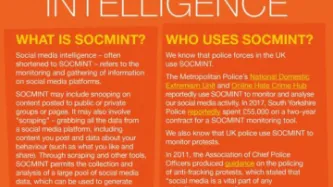
Social media platforms are a vast trove of information about individuals, including their personal preferences, political and religious views, physical and mental health and the identity of their friends and families.
Social media monitoring, or social media intelligence (also defined as SOCMINT), refers to the techniques and technologies that allow the monitoring and gathering of information on social media platforms such as Facebook and Twitter which provides valuable intelligence to others…

Content Type: Long Read
It is common for families with no recourse to public funds who attempt to access support from local authorities to have their social media monitored as part of a ‘Child in Need’ assessment.
This practice appears to be part of a proactive strategy on the part of local authorities to discredit vulnerable families in order to refuse support. In our experience, information on social media accounts is often wildly misinterpreted by local authorities who make serious and unfounded allegations…

Content Type: Report
It is common for families with no recourse to public funds who attempt to access support from local authorities to have their social media monitored as part of a 'Child in Need' assessment. This practice appears to be part of a proactive strategy on the part of local authorities to discredit vulnerable families in order to refuse support. In our experience, information on social media accounts is often wildly misinterpreted by local authorities who make serious and unfounded allegations…